Back to Blog

Landlord Registry Programs Across America

From simple contact databases to complex licensing systems—how landlord registry programs across America have evolved, and what Jacksonville landlords should learn from other cities.

By Paul Howard
July 3, 20267 min read
landlord registryJacksonvilleregulationrental licensingFlorida
Landlord Registry Programs Across America

For years, landlord registration programs were relatively uncommon in the United States. They were typically limited to a handful of cities with aging housing stock or chronic code enforcement problems. The original goal sounded reasonable: create a database of rental properties, identify owners quickly during emergencies, and improve communication between local governments and landlords.

Today, landlord registries have become far more common—and far more controversial. Across the country, many cities have expanded simple registration programs into complex regulatory systems involving annual fees, mandatory inspections, licensing requirements, rental certificates, reporting obligations, and substantial civil penalties. In several jurisdictions, what began as a basic contact database eventually evolved into a comprehensive rental housing regulatory program.

For Florida landlords, especially those following Jacksonville's proposed landlord registry, understanding how these programs have evolved elsewhere provides valuable insight into what may come next.

The Original Purpose - Most landlord registry ordinances begin with similar objectives. Local governments typically cite several reasons for creating a registry:

  • Identifying the owner of rental property
  • Providing emergency contact information
  • Improving code enforcement
  • Tracking rental housing inventory
  • Communicating health and safety information
  • Assisting first responders
  • Improving neighborhood quality

On paper, these goals appear modest. A registry simply becomes a list of rental properties and their owners. Few landlords object to local governments having accurate ownership information—particularly since ownership records are already maintained through county property appraisers. The debate usually begins after the registry has been established.

The Typical Evolution

Across the country, landlord registry programs often follow a remarkably similar pattern.

Phase One: Registration - Initially, landlords are required to provide:

  • Owner name
  • Mailing address
  • Property address
  • Emergency contact
  • Number of rental units

Registration fees are often minimal—or waived altogether during the first year. Local officials emphasize that the registry is "simply informational."

Phase Two: Annual Renewal - Within a few years, many programs require:

  • Annual renewals
  • Updated ownership information
  • Registration fees
  • Proof of insurance
  • Local property manager designation

Failure to renew frequently results in fines.

Phase Three: Mandatory Inspections

Many cities eventually link rental property registration to mandatory inspection programs. These programs require regular inspections of the property to identify building code violations and any damage.

  • Code violations should obviously be corrected by the property owner with or without mandatory inspections.
  • Damage is typically the tenant’s responsibility, as owners rarely deliberately damage their own property.

However, if inspections reveal tenant-caused damage, the owner is usually still required to pay perform the repairs and then seek reimbursement from the tenant. In practice, recovering those costs is difficult if not impossible.

In addition, Landlords may be required to:

  • Schedule inspections
  • Correct violations
  • Obtain rental certificates
  • Pay inspection fees
  • Submit additional documentation

Some jurisdictions prohibit renting property until inspections are completed.

Phase Four: Licensing

Then, many communities eventually transition from registration to landlord licensing. Instead of merely registering property, owners must obtain permission to operate rental housing. No license, No rent. Requirements sometimes include:

  • Educational courses
  • Licensing fees
  • Criminal background checks
  • Property management standards
  • Continuing education
  • Periodic renewals

Phase Five: Expanded Regulation

Once a comprehensive landlord database exists, additional regulations often become easier to administer. Examples include:

Each change may appear relatively minor. Collectively, they can substantially increase the cost and complexity of owning rental property.


Real-World Examples

Los Angeles, California

The Los Angeles Systematic Code Enforcement Program (SCEP) began as a housing inspection initiative.

Today landlords pay annual inspection fees, properties undergo recurring inspections, and violations may trigger additional enforcement actions. The program has expanded considerably since its original implementation and now represents one of the nation's largest rental inspection systems.

Minneapolis, Minnesota

Minneapolis requires nearly every rental property to obtain a rental license. Properties undergo regular inspections. Repeated violations can lead to increased inspection frequency, administrative penalties, or license revocation. Operating without proper licensing may result in significant enforcement actions.


Florida Landlord Network — Evictions Done Right. Done Fast. Flat fee starting at $395.00. Call 800-809-1530. FLALandlord.com. Statewide coverage.

Baltimore, Maryland

Baltimore requires rental properties to be both registered and licensed.

Landlords must:

  • Register properties
  • Pass inspections
  • Obtain lead certification where applicable
  • Maintain rental licensing

Without a valid license, owners generally cannot legally rent their properties.

Philadelphia, Pennsylvania

Philadelphia's rental licensing program requires:

  • Rental licenses
  • Business licenses
  • Lead paint compliance (where applicable)
  • Current tax compliance

Failure to satisfy any requirement can delay licensing or rental activity.

Rochester, New York

Rochester established one of the nation's earliest proactive rental inspection programs. Rental properties are periodically inspected before renewal of certificates of occupancy.

Many other cities later adopted similar inspection models.

Broward County, Florida

Closer to home, Broward County recently adopted a rental registration program for properties in unincorporated areas.

While the current requirements are relatively limited, many Florida landlords are watching carefully to see whether additional inspection or licensing requirements eventually follow.

There are many, many others. Los Angels, Oakland, San Francisco, nearly all of Washington state and Oregon, Boston, New York,, and on and on.

The Financial Impact

Registration fees alone rarely concern landlords. The cumulative costs often do. As programs expand, owners may face:

  • Registration fees
  • Inspection fees
  • License fees
  • Reinspection fees
  • Administrative penalties
  • Permit costs
  • Compliance expenses
  • Legal fees

For landlords with multiple properties, these costs can become substantial.

Supporters See Benefits - Supporters argue that landlord registries:

  • Improve accountability
  • Help eliminate unsafe housing
  • Improve emergency response
  • Encourage better maintenance
  • Reduce neighborhood blight
  • Improve communication between landlords and local government

Many municipalities also argue that registries help identify absentee owners and improve compliance with housing codes.

Critics Raise Concerns - Opponents often counter that ownership information already exists through county property appraiser records and tax rolls. They argue that registries frequently become:

  • Revenue generators
  • Expanded inspection programs
  • Licensing systems
  • Additional bureaucracy
  • Administrative burdens
  • New opportunities for future regulation

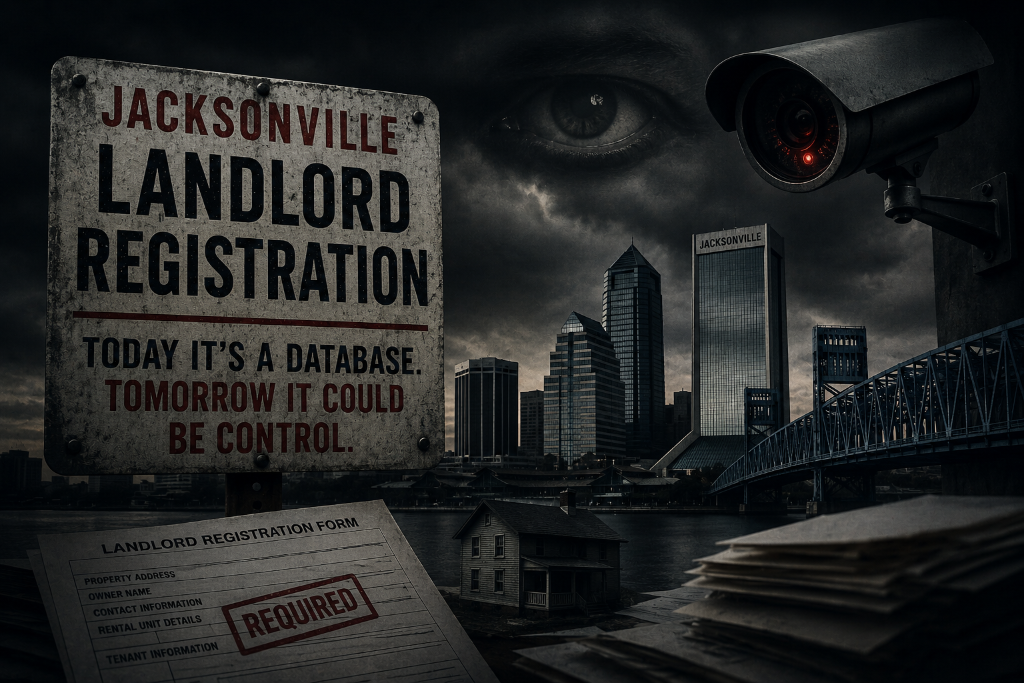
Perhaps the biggest concern is not what a registry requires today—but what future city councils may decide to require once the infrastructure already exists. History suggests that once a landlord database has been created, adding new requirements becomes considerably easier.

What Jacksonville Landlords Should Watch

As Jacksonville debates landlord registration, property owners should ask several important questions:

  • Why is Legal Aid Society, a tenant advocacy group, in charge of the data?
  • Is existing ownership information already publicly available?
  • Will registration remain voluntary or become mandatory?
  • Will annual fees increase over time?
  • Could inspections eventually become mandatory?
  • Could licensing requirements follow?
  • Who will have access to the information?
  • How will the program be funded in future years?

The answers may shape Jacksonville's rental housing market for decades.

Lessons From Other Cities

History doesn't necessarily repeat itself—but it often rhymes. Across the United States, landlord registry programs have frequently expanded beyond their original purpose. Some remain relatively simple databases. Others have evolved into comprehensive licensing and inspection systems. That doesn't mean every registry will follow the same path.

But history demonstrates that once the administrative framework exists, expanding its authority often becomes much easier than creating it in the first place. For landlords, staying engaged early in the legislative process is often more effective than waiting until new requirements have already become law.

After watching landlord regulations evolve for more than four decades, I've noticed a recurring pattern. New regulations are almost never introduced as sweeping government control. Instead, they're presented as modest, common-sense measures to solve a specific problem. Most people—including many landlords—don't object because the initial requirements seem reasonable.

Then, over time, the program grows. A registration becomes a fee. A fee becomes an inspection. An inspection becomes a license. A license becomes another annual renewal, another form, another compliance requirement. Will that happen everywhere? No. But it has happened often enough that landlords should pay close attention whenever a new registry is proposed.

The question isn't whether Jacksonville should know who owns rental property—it already does through public records. The bigger question is what the registry could become five or ten years from now. That's the conversation every landlord should be part of today, not after the next ordinance is introduced.

Click Here for Talking Points in case you want to speak with your city councilman about this:

Disclaimer: Florida Landlord Network is a non-attorney service. This article is for informational purposes only and does not constitute legal advice. Consult a licensed Florida attorney for guidance specific to your situation.

Stay Informed

Get Florida landlord news and legal updates by email.

We use your email to send you our newsletter. See our Privacy Policy. Unsubscribe at any time.

Comments

Comment submission is temporarily unavailable while we review our moderation process.

Important Notice: Florida Landlord Network is an independent, non-attorney service. We urge you to consult an attorney before relying on any publication, using any document or described procedure found herein. Florida Landlord Network is not licensed by the Florida Bar to practice law and is not authorized to give legal advice or tell you your legal rights.