A recent report from Washington State should give Jacksonville landlords pause.
Just one year after Washington adopted one of the nation's most aggressive rent-control laws, state officials report that more than $800,000 in penalties have been assessed against landlords accused of violating the new regulations. According to published reports, many of the violations involved paperwork, notice requirements, rent increase calculations, and other technical compliance issues rather than unsafe housing conditions.
The lesson for Jacksonville may have less to do with rent control itself and more to do with something else entirely:
The power of regulatory infrastructure.
The Most Important Question
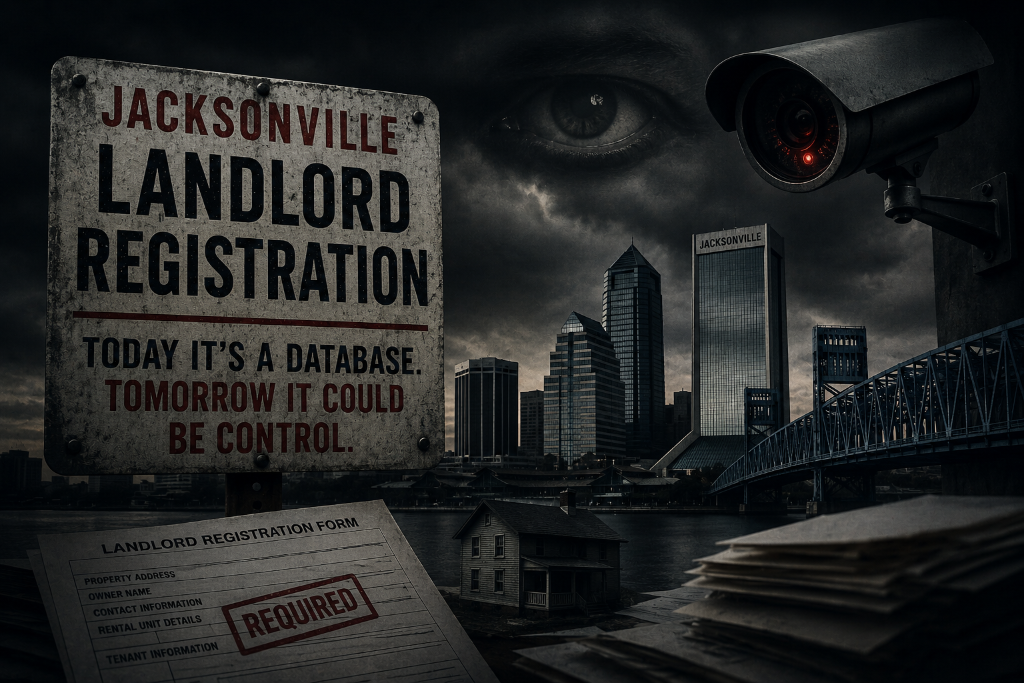
Jacksonville's proposed Rental Registry has largely been promoted as a tool to help tenants identify and contact landlords. But buried within the proposal is a detail that deserves far more public attention.
The registry database would be maintained by Legal Aid.
"Jacksonville Area Legal Aid (JALA), a nonprofit law firm focused on housing justice for low-income residents, will spearhead the rental registry initiative." (WJXT)
That raises a simple question:
Why does the Jacksonville Councilman want to create a landlord database run by an advocacy organization?
Legal Aid performs valuable work in our community and advocates for tenants facing housing challenges. But Legal Aid is not a neutral government agency. It is an advocacy organization whose mission includes advancing tenant interests and influencing housing policy.
The issue is not whether Legal Aid's goals are good or bad.
The issue is whether landlords should be required to provide information to a centralized database maintained by an organization that routinely advocates on housing issues affecting landlords and rental property owners.
Many landlords view that as fundamentally different from a registry operated by a neutral city department -- which could also be used as powerful regulatory infrastructure.
Before such a system is created, city leaders should answer several important questions:
- What problem does this Registry really solve?
- Who controls the information?
- Who verifies its accuracy?
- How are errors corrected?
- Who decides what information becomes public?
- Who has access to the database?
- How might the information be used in future policy initiatives, litigation efforts, research projects, or political campaigns?
These are not minor details. They go to the heart of the proposal.
What Problem Is Being Solved?
Supporters frequently argue that tenants sometimes struggle to identify or contact their landlords.
That claim deserves closer examination.
The rental housing industry has changed dramatically over the past decade. Today, many landlords communicate with tenants through online portals, mobile apps, email, text messaging, and automated maintenance systems. Tenants routinely use these platforms to pay rent, submit maintenance requests, review lease documents, receive notices, and communicate directly with management.
In fact, one of the most common complaints heard from landlords today is not that tenants cannot reach them, but that tenants have too many ways to reach them.
Plus, Florida law already requires landlords or their authorized agents to provide tenants with contact information; And, of course, Property ownership records are free and publicly available through county records.
Before imposing new registration requirements on thousands of housing providers, Jacksonville officials should first demonstrate the scope of the problem and explain why existing laws and modern communication tools are insufficient.
As one Jacksonville landlord recently observed:
"More than one-third of Jacksonville residents live in rental housing. That's more than one-third of the city's voters."
Whether one agrees with that observation or not, it raises legitimate questions about the motivations behind the proposal.